Tuesday, October 9, 2007

Competition is Dying


I have thought twice already tonight about blogging about this, but I have decided to go for it. I have not been known too often to watch what I say when I feel passionately about something, so here it goes.

I was speaking with a dear friend of mine today- probably one of the best competitors of his time. Not because he has won several triathlons, but because he embodies the total definition of a competitor. I believe that he would compete with you in pretty much anything- if you challenged him to a game of "let's see who could change the channel on the TV faster," he would do it and kick your ass doing it. He is a man after my own heart, and I admire him for that.

I, myself, am also a true competitor. One of the best coaches that I have ever had the pleasure of actually working under always said to practice competing in everything you do. Competition has the connotation sometimes of being some type of "negative" or "unfair" action that can get unfriendly, or potentially harmful, to the opponent who happens to lose. If you are not a sore loser, this is not generally the case. But, in most of my cases, I have not felt a loser. A true competitor always feels a sense of winning and is raring to try again.

A terrible event in running history went down this last weekend as many people know- a man died during one of the most famous marathons in this country- the Chicago Marathon. It was pretty hot- 89 degrees, terribly humid, which made for a grueling race. Fairly unseasonable weather-wise, but still- a race. A race in which everyone should have prepared- no matter the conditions. Herein lies my problem about this blog. I DON'T WANT TO SEEM UNSENSITIVE TO THIS MAN WHO HAS PASSED. I truly feel for him and his family/friends. But...

Sport these days has become very politically correct. There are already several lawyers ready to take this case to court and say that this marathon should not have been run on this day because of the conditions. Now- mind you- the race directors, trying to make just a few bucks, let in close to 40,000 people into this marathon. Yes, that many people. Odds are that if you take 40,000 people in a day and put money on it that 1 person in the group might die that day, I bet it could just happen- I mean, what are the odds? The man that died ended up (they have found) having a hereditary heart problem. Could have been exacerbated by the run, but still...

Back to the 40,000 people they let in. Now, several people sign up to compete in what they consider their 1st and last Marathon, just to say that they have done it. Not many people even run a sub 4-hour marathon anymore- people are doing it just to complete it. Good for them- I say. Honestly, good for them. But, what happened to those days where a 3:15 or 3:30 would be a goal time- at least for a woman in my AG. Pretty sure that the women who ran the LA Marathon this last year (seeing that they only had about 9 women pros race) were not nearly as competitive as they were even 10 years ago.

Now, I speak from experience. I did my first Marathon on May 14th, 2003. The Innagural Fargo North Dakota Marathon. Yes, Fargo. I got there on May 13th, 56 degrees and sunny. Beautiful. Woke up the next morning- 20 degrees F and snow on the ground. Wind chills reaching ZERO degrees. No cancelling of the race. A few people with hypothermia, but I adjusted my pace for the conditions and ran my race. Know your capabilities. I still ran a sub 3:50 in sub-zero temps in sub-perfect conditions. I was smart. I ran my race. I was trained. I am an athlete.

Kona- the Championship of Triathlon- has temps that surpass this 89 degrees every year. I mean, crazy humid and hot as hell. An Ironman distance- not just a marathon. Not to mention the winds...300 people will visit the med tent this weekend, out of only 1500 that are allowed to race (yes, you actually have to qualify for Kona). 300 out of 40,000 marathon runners in Chicago- 1 death- not too bad, considering the odds. (once again, not being insensitive, just stating the facts).

Swims get cancelled all the time now if the waves get above 3 feet or if the current is too strong. What happened to the days where it was, "finish the swim, or you can't race". No cancelling swims, "back in the day" (early-mid '80s..even into the 90s I am sure). I mean, I want fair competition. I don't want a cancelled swim. I don't care how cold the water is. Get in and swim, you wuss. Prepare for the worst during your training. Take personal responsibility.

People are so damn sensitive these days and feel a need to be absolutely politically correct. Everyone has a lawyer to protect them in the case that they are not taken care of correctly, regardless of how much they have prepared or trained. Watch out, race directors. In your quest to make a few bucks in a race you are letting in a wave of peeps who want nothing more to rip you a new one had you created a poor race experience for them. I read a quote once that went something like this..."If you can please a triathlete, you have got it made." That is the case- thank God I am not that anal.

Whew, that felt good.

Now, if you are racing to finish a race, and that is your goal, congratulations. I am seriously happy for you. But, as you race more and get better, your confidence will increase and that spark of competitive edge might come to the surface. Embrace it, for I fear that the expectations for the athletes of today are becoming lower simply because we have to round down to the lowest common denominator. Don't be that LCD. Compete because you want do to well- do more than just finish. And, don't get mad when the weather is not as you wanted or expected. After all, races are not perfect and neither are you.

Shut up and Race!

Have a great week,
Coach E

Friday, October 5, 2007

Put "I" First


Ever thought of taking personal responsibility to make your day a GREAT ONE? Yeah, imagine that- YOU are in control of how your attitude is for the day. Who would have thought? So, the next time you look to external causes for why you didn't perform the way you wanted to in the race, or why you didn't make it practice that day, or why you didn't get the proper recovery nutrition in and thus didn't have the energy to be the best you could be- look inside yourself and find your own control of your actions. Believe that you can make yourself better.

Have a Great Weekend!

Taken from "THE GIFT OF LOVE"- by Dan Baker

YOU CAN LOVE ME
BUT ONLY I CAN MAKE ME HAPPY.

YOU CAN TEACH ME
BUT ONLY I CAN DO THE LEARNING.

YOU CAN LEAD ME
BUT ONLY I CAN WALK THE PATH.

YOU CAN PROMOTE ME
BUT I HAVE TO SUCCEED.

YOU CAN COACH ME
BUT I HAVE TO WIN THE RACE.

Wednesday, October 3, 2007

If I Wasn't a Triathlete, I would play...


I really miss playing volleyball. Having played since 6th grade, and have coached since 2001, I realize how much I love the game. I still keep myself pretty involved by giving private lessons to high school players in the Santa Clarita Valley. I absolutely am energized by these girls that I get to work with as they possess that same passion that I had when I played. Now, I was a setter- which means that I set up the hitters for each play as they either swung outside, middle, or rightside. As a setter, you run the offense- essentially, you are the "quarterback" of the team. So, you get to know all of the positions really well. As a coach, that is a major benefit to me. At this current time, I am working with about 8 girls on a regular basis. 3 setters, 3 outside hitters, 1 rightside hitter, and 1 middle. I am pretty stoked about training all of them, as they all are very good competitors and good students. That helps a lot because usually with good grades comes a strong work ethic and that is always so great as a coach working one-on-one with a player. Tomorrow night, I get to go to the actual high school games so I can watch my players play in a game situation. It should be exciting! Anyway, just thought I would restate how much I miss the game and I look forward to playing more in the off-season. If I ever get out of tris, I will make it to the AVP :)

Have a great Thursday!

Tuesday, October 2, 2007

Have a Goal Snowball


If you are anything like me, you have GOALS. But, what exactly does having goals entail? Most times, we have goals an they are saved up in our memory and not clearly visible or revised or, at times, even defined. I have recently learned of a new way to think about the goal reaching progress, which might help you to learn how to pick away at the things that might be holding you back from your long term goal.

If you think about your big goal as a series of smaller goals to tackle on your way to the big goal, you are in effect, working on your goal snowball. Here is a process for you to put into practice this week. Think of 5 things you want to accomplish- things meaning behaviors or habits that you want to zero in on making better or changing. You can think of them in the training sense, or nutritional sense, or even in the sense of your lifestyle. After all, if you are not happy, you will not feel good, and as a result, not look good. Follow these 5 steps to reaching your goals and pretty soon, you're on your way to one giant attainable snowball.

Check it out:

1) Think of five or six behaviors you need to improve or change to reach your physique or performance goals.

2) List these things and put the easiest attainable goal at top.

3) "Maintain" all your other goals and focus your attention on the easiest behavior/habit first.

4) Once that change has been made you can move up to the next item on your list and focus your efforts on that one- then, repeat steps 1-4.

5) Pretty soon, all of your changes and/or goals will have been met.

Basically, think BIG PICTURE, but also keep in mind that it takes baby steps to get there.

Monday, October 1, 2007

I WANT TO GET FASTER ON THE BIKE!!!!!

I am in the middle of completing an assignment regarding a case study of a cyclist who's goal is to get FASTER. An all-too-common goal for all of us triathletes, I was reading up on what some of the experts were saying and I came across the TESTA TEST- written by Max Testa, who is one of the most famous cycling coaches, most recently, aiding Levi Leipheimer in getting faster for the TDF, as well as having helped coach some of the first pro cycling teams (Team 7-Eleven) back in the day. Testa basically established the theory that the strongest cyclist is the one who can climb in the biggest gear, at the highest cadence, for the longest period of time. Sound familiar, Lance Armstrong? Al Lyman (bio below) published the TESTA TEST, and I wanted to post it today on my blog. Something for us to try in the off-season to see where we are all at when it comes to power output.

Coach Al Lyman, CSCS, is certified with USA Triathlon, the Triathlon Academy, and the National Strength and Conditioning Association, and is the founder of Pursuit Fitness (www.pursuit-fitness.com). In addition to coaching athletes of all levels in the U.S. and abroad, he is also a 8-time Ironman Triathlon Finisher (3-time Hawaii Finisher) with a 10:29 PR, and holds a 2:39 PR at the Boston Marathon.


The Testa Test for Finding Your Optimal Cycling Cadence
(The information below is taken from: http://velo-irk.ru/info/SPIN%20SCIENCE.htm)

How do you determine what cadence is best for you?

There is one test for determining your optimal cadence created by Max Testa, that I believe is perfect for most of us to use as a reliable testing protocol and it also happens to be a great way to find out what your strengths and weaknesses are on the bike, i.e. whether you need further development in strength vs. aerobic conditioning.

Testing Your Cadence With Hill Repeats (The Testa Test)

One of the best ways to experiment with different cadences is when you are in the middle of doing “hill repeats” in a specific hill repeat session. Your body will tell you what style cadence works for you by the feedback you get as you hit maximum on your climbing repeat test (Testa Test). You must wear a Heart Rate Monitor in order to get accurate feedback. Also, you should pay attention to your body's reactions (HR, breathing, power meter, speed, perceived exertion, and INSTINCTS) during this test to get an accurate determination about what cadence style suits you best and you will have to repeat this test several times to get an accurate measure.

Testa describes one possible reaction as: "Do you shift to a lower gear and spin fast because if you go to a bigger gear and grind your legs, you’ll die? In that case, you need to be stronger."


Testa also describes,"But, if you use a smaller a gear and spin, and your breathing goes out of control, you need more cardiovascular development."

Optimal Cadence Testing Protocol (Testa Test)

On a day when you are well rested and feeling good, get on the bike and ride to warmup for at least 20-30', bringing your heart rate up into your zone 2.


While you warm up, ride toward a fairly steep hill (but not REALLY steep - about 6-10% on avg. will work great!), and do 3 x 3-4' HILL repeats, all while seated and all hard efforts, with an easy spin down recovery.

Important: Choose a gear and cadence for these repeats that feels most comfortable to you! It may be slower, or it may be faster. Choose your most preferable cadence, and then work it!! Since you are going to perform 3 repeats up the hill, be sure to pace yourself on the first, so that you can finish all three reps strong!, and then cooling down for the day.

On the second "repeat", you’ll be warmed up but hopefully not yet “toasted.” When you’re near the top or the end of the climb, push as hard as you can! Near the top, at the point where you begin to lose power and your pedal stroke gets ragged, shift to a harder gear and try to maintain the same speed. Pay attention to what happens (HR, speed, perceived exertion, etc.)

Then recover (4-5 min) with a light spin and prep for repeat 3...

On the third repeat, when the going gets tough, shift to an easier gear and try to spin at a higher cadence. Compare your feelings, sensations, and SPEED to the first and second repeat.
Done several times, this experiment should tell you whether you’re more efficient as a spinner or a grinder. It should also reveal if you need to work on leg strength and power or cardiovascular conditioning in order to become a better climber and cyclist.


Obviously, if you are training “with a power meter,” that can be an excellent way to gauge what’s happening. With the benefit of being able to see BOTH heart rate and watts, you can instantly tell which “way” is more efficient.

Keep in mind that this is only a representation of a test that you could do, over the course of a couple of different sessions, to hopefully see a pattern over time. Be patient, one will eventually emerge. If you’re listening closely to your body and feelings, you’ll find that cadence “sweet spot,” and you’ll be much more in tune with your body when racing.
Finding your cadence "sweet spot" takes practice and discipline. Be patient and LISTEN to your body!


Just one more reminder: all this talk about finding a cadence “sweet spot” doesn’t take away the fact that when it comes to cadence, you should nearly always err on the side of caution by turning an easier gear, rather than a larger one. This transfers stress to your cardiovascular system and saves the leg muscles from undue fatigue.

Thanks, Coach Al. All something we should pay closer attention to when thinking about developing max power on the bike. Don't forget about strength training in the gym in the off-season as well. More to come on that topic...

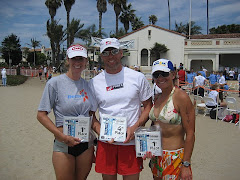
Clancy, Mike and I

Clancy, Mike and I
SB Tri Finishers- Nice Tiles!